

How Do Venture Capital Firms Make Money
Today, we can't deny that startups have found a special space in the business ecosystem. They have become so much an important office that our daily vocabulary is now full of startup-related words like venture capital letter, seed funding, venture capitalists, collector, etc.
The point is, people assume that everyone read these startup lingos…which is non the case most of the times.
If you found this article along a search engine, chances are that you've encountered venture capital in any of your conversations simply never fully understood the pith concepts prat it, how it is different from holy man investiture, and who exactly is a venture capitalist, etc.
Well, here's a guidebook answering all your questions.
What is Jeopardize Capital?
Risk capital is the funding investors furnish to the high-growth potential startups in exchange for equity in the company.
In a simple circumstance, venture upper-case letter is provided to startups (not any new company) which are growing at a remarkable rate and are in need of money to sustain that maturation. The investor, in return, demands equity or an ownership stake in the fellowship.
An example of this commute would be a venture capitalist providing $100,000 to help the inauguration spring u and in come back taking a 10% stake in the company.
What Is A Venture Capitalist?
A venture private enterprise is a professional investor (usually a firm) that funds startups and occupation ventures showing inebriated growth potential in exchange for an fairness stake.
Pretend capitalists are usually navicular every bit controlled partnerships where the partners invest in the VC funds. These partners are unremarkably categorized into two types – the Limited Partners (LPs) and General Partners (GPs).
The limited partners are institutional investors which supply money to the fund, like university endowments, pension funds, insurance companies and early queen-size corporates and high net-valuable individuals.
The general partners (GPs) are dynamic investors WHO make the decisions on where, how, you bet much to invest. They are usually manufacture veterans with business, research, and entrepreneurial experiences WHO take in a sound noesis of their niche and the startup ecosystem.
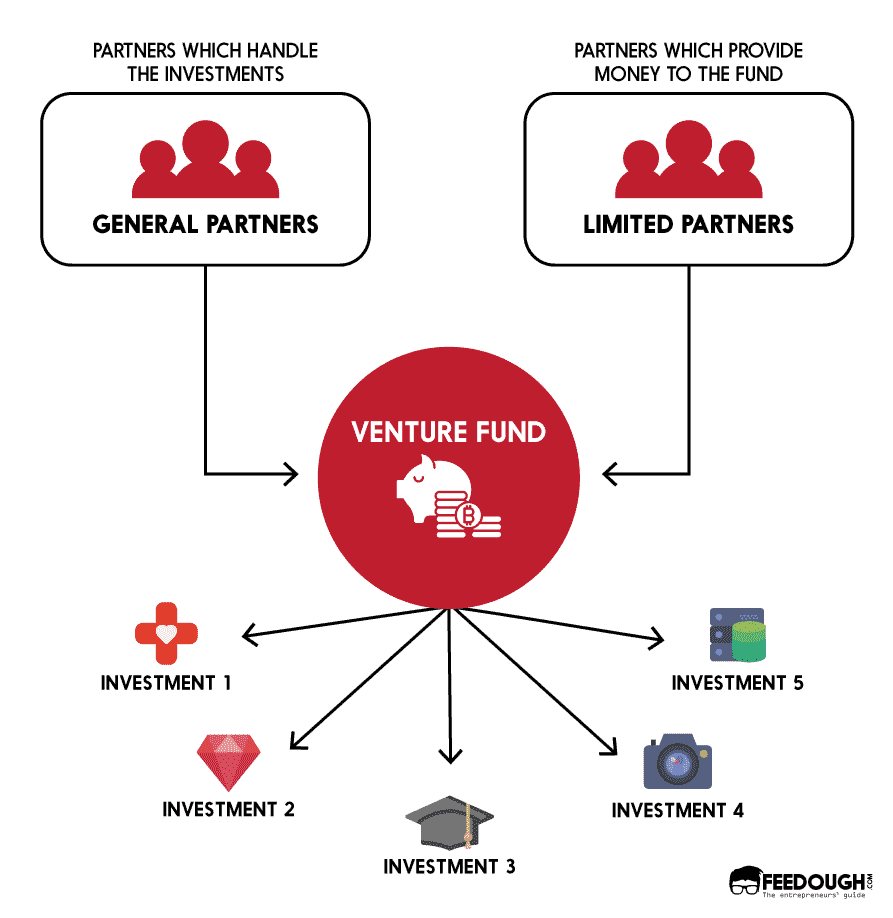
Since their money is on the bet, VCs likewise provide steering and focusing to the companies they vest in and take an sporty part in the decision-devising process too.
Still, contrary to the usual belief, VCs preceptor't usually fund companies that have just started. As a matter of fact, to a lesser degree 1% of companies receive venture capital. Moreover, bringing up venture uppercase is a lengthy and stressful process and involves a lot of examinations from the investors' incline.
But entrepreneurs still attend the VCs. Why, you ask?
Why Do VCs Survive?
A interrogative sentence that must receive crossed your mind is wherefore dress VCs exist? Can't startups attend the banks Beaver State fiscal institutions to fund their ideas and former-stage companies?
Well…they can't.
Venture capital's niche exists because banks are not willing to take risks funding azoic-stage startups (of which 9 out of 10 fail). Flatbottomed if they dress, they do it with unpeasant-smelling interest rates and exclusively to the extent of the scheming assets against which they can secure the loan.
Now, SBA loans execute exist. But piece they might be good for small businesses, startups often call for a lot of financial support as they architectural plan to cut off the whole industry.
This need resulted in an all-new niche where masses (angel investors), corporates, and even business enterprise institutions invest money in promising ventures, help them originate, and make profits by exiting with most profits.
How Venture Capital Works?
Startups raise venture capital in instalments known as venture rounds. These venture rounds add the types of venture capital that exists.
- Pre-Seed Financial support: It is required to validate the product hypothesis and build an Most valuable player. Usually, not much investment is required at this stage and almost none stake free enterprise invest during the pre-seed financial support phase unless IT's one of their partners' venture.
- Seed Financial support: One time the hypothesis agnatic to the cartesian product-grocery fit is validated, entrepreneurs look on for seed funding. This investment is accustomed set-in the lead the company, build the genuine intersection, and start fully fledged operations. Most venture capitalists stay away from seed funding As most of the financial needs of the companies at this stage (unremarkably betwixt $500,000 and $2 zillion) are met by fundings from angel investors (peaky-last-valuable individuals) or banks. Moreover, they get into't invest in companies during the seed stage arsenic startups have a high-pitched risk of failing during this stage.
- Series A-F: Once the startup starts receiving traction in the variety of the number of users, revenue, views, Oregon other KPIs, it becomes prepared to raise a series A funding to grow and expand. This is where most of the guess capitalists come in. Series A cycle is followed by 5 Thomas More rounds. However, according to CB Insights, only 48% of the companies try for a indorse round of the financing (after the seed round), and only 15% of the companies try for a Series C round.
According to HBR, around 80% of the embark capital goes into the infrastructure required to grow the inauguration. This includes expense investments (manufacturing, marketing, and sales) and the balance sheet (providing regressive assets and capital).
Symmetrical though venture capital is an important investment for the startups, it really isn't a semipermanent investment from the venture free enterprise's point of view. Their contrive is to seat in the ship's company's growth until the time information technology reaches sufficient size and is credible enough to be sold to a corporation or some another political party.
In simple footing, they buy a stake, nurture it trough it becomes profitable, and exit it As soon as they can.
Risk capital Process
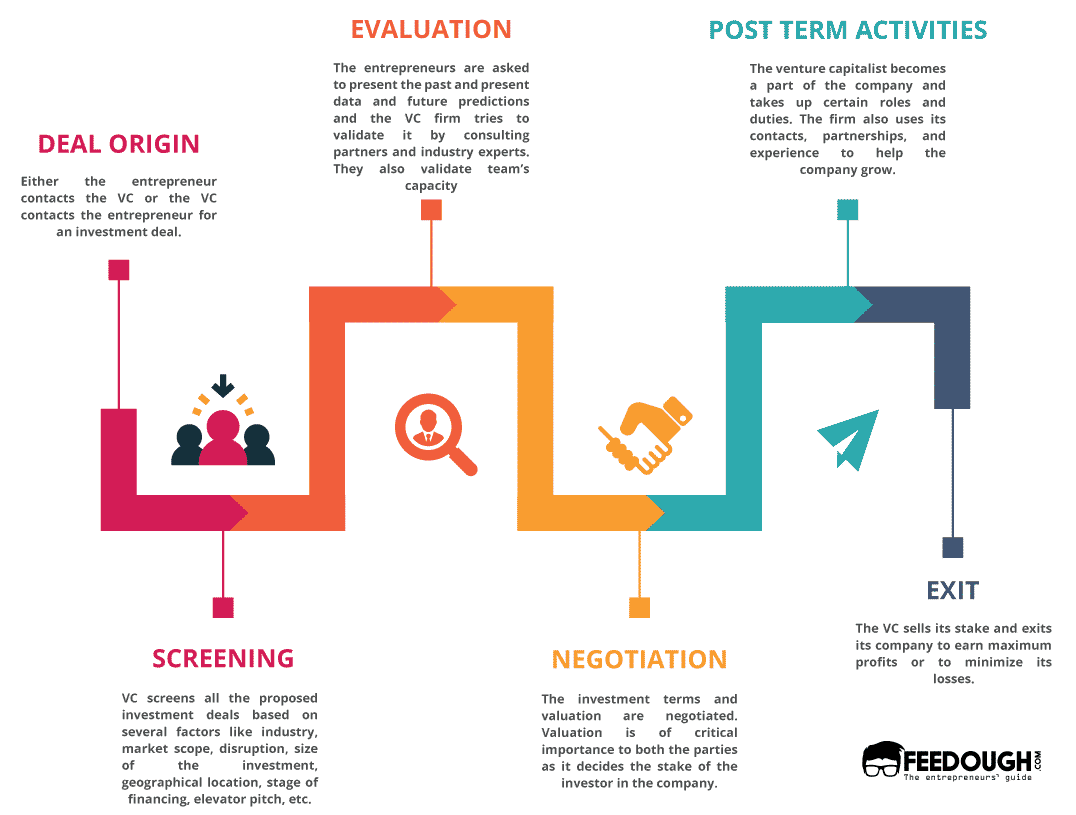
While the speculation capital process is really complex and works a bit differently for different VC firms, we've tried and true to break information technology down into six steps which come out with them acquiring the proffer to invest and end with them exiting the companionship.
Deal Origination
An investment funds deal give the sack originate in various ways. Either the entrepreneur contacts the firm directly, or the partners engender to attestor the inauguration in competitions, meetups, news, surgery get along a customer themselves; Beaver State the deal can originate in the form of a referral by business partners, parent organisations, friends etc.
Screening
This stage involves the screening of all the proposed investment deals. The projects are screened founded on some factors like industry, market scope, hoo-hah, size of the investment, geographical location, degree of funding, elevator pitch, etc.
The most promising projects orbit the next stage which involves a more than detailed evaluation.
Evaluation
Once the possible projects are chosen from the lot, the evaluation begins.
This stage involves a mete out of effort from both the parties. The entrepreneurs are asked to present the past and acquaint data and next predictions and the VC steadfastly tries to validate it away consulting partners and industry experts.
In the evaluation stage, the VCs non just evaluate the product's capacity just also the squad's capacity to se the proposed claims. The project passes this present only if they feel that the goals are possible and the team has relevant skills, competency, ability, and feel to make it happen.
Risk direction is also done to evaluate the ROI by guardianship the forecasted risks alongside.
Damage & Valuation Negotiation
Once the evaluation is complete, the investment terms and rating are negotiated. Valuation is of evaluative importance to both the parties as IT decides the bet on of the investor in the fellowship.
Evaluation is torn into cardinal segments – pre-money valuation and post-money valuation. The pre-money evaluation is the agreed-on value of the company before the investment is made and post-money valuation is the valuation later the investment funds is made.
Suppose the parties agree along a (pre-money) rating of $40M and the investor pitches in $20M, the mail-money valuation will be $60 million and the investor's stake in the companionship testament be 1/3 or 33.34%, at the closing of the financing.
There's no unrivaled right formula to decide the valuation of the company and some the parties have their suppose during the negotiation. The entrepreneur tries to stay fresh the valuation as flooding as possible while the investor tries to keep information technology low to have a higher stake.
The evaluation along with other damage are included in a term plane developed by the VC. Here are some some other elements that are included in the term sheet of paper–
- Selection Pools: It's a pool of stocks reserved for employees or upcoming employees of the inauguration.
- Liquidation Preference: It is a kind of safety network for the investors which gives them penchant to get some money back in the case of the inauguration failing. In simple terms, at the fourth dimension of the elimination, the investors surgery other preferred stockholders get back up to a percentage (usually 100% or 1x) of the amount they invested in the company before any other common stockholder gets anything. Of course, none same gets anything if totally the money is lost.
- Participation Rights: Participating right or active pet favours the investors to a greater extent. It is a type of extermination preference where the investor gets 1x of his investment back but likewise gets his proportional plowshare of any cash that clay after that. For example, say a venture capitalist with preferred stock has $1M liquidation taste with participation rights and owns 20% of the crest table. Suppose the company sells for $10M. He gets back the $1M As his preferred shares too as the 20% of the remaining $9M, which comes out to be $1.8M, because he had engagement rights. This leaves $6.2M to be divided between coarse shareholders and the founders.
- Dividends: The terms maternal to dividends (cumulative, not-cumulative, and anti-dilution rights) are also decided in the term sheet.
- Card of Directors: The entry of the venture capitalist makes IT somewhat obligatory for the entrepreneurs to define the panel of directors usually with one seat ordained to the investor.
- Investor Rights: This section discusses the various rights the investor wish be able to exercise in the company. Lawyers intervention is necessary to interpret this section.
- Founder Vesting: This section of the VC term sheet is designed in some respects to keep the founders engaged with the company for the longest time. A vesting schedule is developed where the founders' stock becomes subject to vesting based on continuing utilisation and becomes earned usually after four years.
Post Investment Activities
Once the terms are accepted and the deal is finalised, the venture capitalist becomes a part of the company and takes up certain roles and duties. The firm also uses its contacts, partnerships, and experience to help the party grow.
However, most of the VCs don't take off an actual part in the Day-to-day operative of the party and only intervene when the company deviates from the set finish or at the time of a financial crisis.
That being same, the firm's representative does turn a part of the company's board of directors.
Exit Plan
VC makes money by exiting the companies with most profits. It becomes a part of the company only to help IT grow and increase the evaluate of its shares.
An exit plan is when, how, and to whom the VC testament sell its shares to minimize losses and maximise net profit. It May exit finished an IPO, attainment by another company, trite buyback, or other ways.
Venture Capital Advantages And Disadvantages
It's true that investments cannot be denied in most startups. Merely they have their personal costs too, especially in the case of venture capital where millions are on stake.
Advantages of Venture Capital
- Growth Opportunities: The inflow of new capital brings many new growth opportunities along and gives the chance to the business to explore recent markets and improve the operations.
- Business Expertise: Besides financial mount, VCs also pull in business expertise and a different perspective. They use their experience to provide guidance and consultation and help the company make better decisions and manage effectively.
- Additional Resources: VCs also lend their resources to assistance their new partners when it comes to unfavourable areas like taxes, finance, personnel matters, etc.
- Connections: VCs that articulation the caller's instrument panel usually have much of connections which eventually helps the company in the long run.
Disadvantages of Risk capital
- Loss of control: With the VC joining American Samoa a film director of the company, the founders fall back a substantial amount of control arsenic they held previously. They now have to consult the person before taking long term decisions.
- Dilution Of Ownership: The ownership stake too reduces equally a proportion of the shares are tending to the VC in exchange for the investment.
Go On, Tell Us What You Think!
Did we miss something? Come on! Tell us what you think of our clause onventure capital and venture capitalists in the comments section.

A inauguration consultant, dreamer, traveler, and philomath. Aashish has worked with all over 50 startups and successfully helped them imagine, heighten money, and succeed. When not working, he can be found hiking, camping, and stargazing.
How Do Venture Capital Firms Make Money
Source: https://www.feedough.com/venture-capital-venture-capitalists-a-beginners-guide/
Posted by: rabideaucomplem.blogspot.com
0 Response to "How Do Venture Capital Firms Make Money"
Post a Comment